IELTS Speaking: How the Test Works and 10 Tips for a Higher Band
Understand the three parts of the IELTS Speaking test, what examiners are listening for, and ten practical tips to help you speak with more confidence.
26 September 2026 · 7 min read
The IELTS Speaking test makes many people nervous. But it’s the most predictable part of the exam: the format is always the same, and you know exactly what the examiner is listening for. Once you understand how it works, you can prepare in a smart way.
How the test works
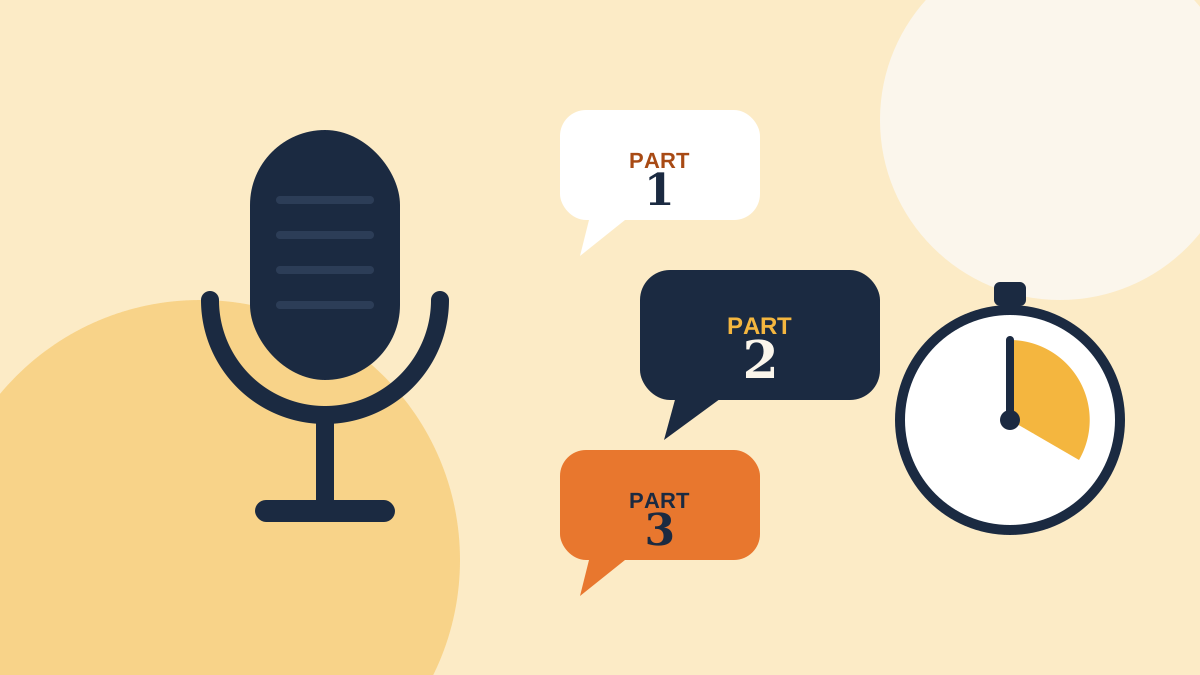
The Speaking test is a face-to-face conversation with an examiner and takes 11 to 14 minutes. It is the same for IELTS Academic and IELTS General Training, and it is recorded. It has three parts.
| Part | Time | What happens |
|---|---|---|
| Part 1: Introduction and interview | 4–5 minutes | The examiner asks questions about familiar topics: your home, work or studies, hobbies, daily life. |
| Part 2: The long turn | 3–4 minutes | You get a task card with a topic. You have 1 minute to prepare (you can make notes), then you speak for up to 2 minutes. |
| Part 3: Discussion | 4–5 minutes | The examiner asks more abstract questions linked to your Part 2 topic. You give opinions, compare and explain. |
What the examiner is listening for
Your score is based on four things, and each one counts equally:
- Fluency and coherence: Can you keep talking without long pauses, and are your ideas connected and easy to follow?
- Lexical resource: Do you use a good range of vocabulary, including less common words and natural phrases?
- Grammatical range and accuracy: Do you use different sentence structures, and how many mistakes do you make?
- Pronunciation: Are you easy to understand? Do you use stress, rhythm and intonation naturally?
Notice what is not on the list: your opinions, your knowledge, or whether your story is true. The examiner is only assessing your English.
10 tips for a higher band
1. Extend every Part 1 answer
“Yes, I do” is too short. Aim for two or three sentences: answer, give a reason, add a detail or example.
Do you enjoy cooking? “Yes, I really do, especially at the weekend when I have more time. Last Sunday I tried making a Thai curry for the first time, and it was surprisingly good!”
2. Use your Part 2 minute wisely
Don’t write full sentences. Write four or five keywords, one for each point on the card, plus one or two good words you want to use. Then look up and speak.
3. Tell a story in Part 2
Stories are easier to talk about for two minutes than lists of facts. Use a simple structure: when and where → what happened → how you felt → why it matters to you. This is exactly the skill you practise when you retell a Bright Lives story.
4. Keep going until the examiner stops you
In Part 2, keep speaking for the full two minutes if you can. If you run out of ideas, add a detail, give an example, or talk about how you felt.
5. Give reasons and examples in Part 3
Part 3 is about ideas. Show that you can explain, compare and speculate: “I think the main reason is…”, “Compared to twenty years ago…”, “In the future, it’s likely that…”
6. Buy time naturally
Everyone needs a moment to think. Use natural phrases instead of silence or “ummm”:
- “That’s an interesting question. Let me think…”
- “I’ve never really thought about that before, but…”
- “It’s hard to say, but I suppose…”
7. Learn vocabulary by topic, in phrases
Common IELTS topics include work, education, technology, the environment, health, travel and family. For each one, learn natural phrases, not just single words: “a healthy work–life balance”, “to cut down on sugar”, “to make a difference”.
8. Mix your grammar
Try to use a range of structures naturally: past tenses for stories, conditionals (“If I had more time, I would…”), comparisons, and relative clauses (“a friend who…”). Don’t force complex grammar. Accuracy matters too.
9. Don’t memorise answers
Examiners are trained to notice memorised answers, and they sound unnatural. Instead, practise talking about topics so you can respond to any question.
10. Record yourself
Answer a practice question, record it on your phone and listen back. You’ll hear your pauses, repeated words and pronunciation problems much more clearly than when you’re speaking. Then try again.
A 15-minute daily routine
- 5 minutes: Answer three Part 1 questions out loud.
- 5 minutes: Do one Part 2 card: 1 minute preparing, 2 minutes speaking, recorded.
- 5 minutes: Listen back and write down three words or phrases that would have made your answer better.
Want topics to practise with? Every video lesson is a great Part 2 topic: “Describe a person who inspires you.”